Introduction: Why Understanding Credit Card Payment Options Matters
Credit Card Full Payment vs Minimum Due represents one of the most critical financial decisions every cardholder faces monthly. This choice directly impacts your financial health, credit score, and long-term wealth building capacity.
Making informed decisions about Credit Card Minimum Due payments can save you thousands of rupees in interest charges while protecting your creditworthiness. Many cardholders unknowingly fall into expensive debt traps by consistently choosing minimum payments over full settlement.
This comprehensive guide explores the real costs, benefits, and strategic implications of both payment approaches to help you make financially sound decisions.
Understanding Credit Card Full Payment vs Minimum Due is essential if you want to avoid high interest charges and debt traps.
If you’re new to credit cards, check out our Complete Guide to Bank Accounts in India to understand financial basics.
If you’re planning your finances in 2026, you should also check the latest FD interest rates in India to understand safe investment options.
According to RBI guidelines, credit card users should clearly understand interest charges and repayment terms before making payments.

What Does Credit Card Full Payment Mean?
Complete Settlement: The Smart Choice
Credit Card Full Payment involves settling your entire outstanding balance before the due date. This approach eliminates all finance charges and maintains your credit card’s interest-free period.
Key Advantages of Full Payment:
- Zero interest charges on all transactions
- Extended grace period of 45-55 days for new purchases
- Improved credit utilization ratio boosting your credit score
- Enhanced financial discipline preventing debt accumulation
- Maximum reward benefits without offsetting interest costs
Practical Example:
- Monthly statement amount: ₹30,000
- Full payment: ₹30,000
- Interest charged: ₹0
- Result: Complete financial freedom
Understanding Credit Card Minimum Due: The Basics
What Constitutes Minimum Due Amount?
Credit Card Minimum Due typically represents 5% of your total outstanding balance plus any overlimit charges, late fees, and previous unpaid minimum amounts.
Minimum Due Components:
- 5% of total outstanding balance
- 100% of overlimit amount (if applicable)
- Previous month’s unpaid minimum due
- Late payment charges and other fees
Important Calculation Example:
- Total outstanding: ₹40,000
- Minimum due calculation: ₹40,000 × 5% = ₹2,000
- Additional fees: ₹500
- Final minimum due: ₹2,500
This example clearly shows how Credit Card Full Payment vs Minimum Due affects your total repayment.
You can also check official credit card terms to understand how minimum due and interest are calculated in credit cards.

Credit Card Full Payment vs Minimum Due: Detailed Comparison
| Payment Aspect | Full Payment | Credit Card Minimum Due |
|---|---|---|
| Interest Charges | Zero interest | 30-45% annual interest |
| Credit Score Impact | Positive improvement | Potential long-term damage |
| Debt Accumulation | No debt carried forward | Increasing debt burden |
| Grace Period | Maintained fully | Completely lost |
| Financial Stress | Minimal stress | High anxiety levels |
| Total Cost | Statement amount only | 2-3x original amount |
The difference between Credit Card Full Payment vs Minimum Due can significantly impact your financial health.
The Hidden Financial Traps of Minimum Due Payments
1. Compound Interest Devastation
Credit card companies charge interest rates between 30-45% annually, compounded monthly. When you pay only the Credit Card Minimum Due, the remaining balance becomes subject to these crushing interest rates.
2. Loss of Grace Period Benefits
Once you carry a balance by paying minimum due:
- New purchases immediately attract interest charges
- No interest-free period for future transactions
- Double taxation effect on your spending
3. The Debt Spiral Effect
Minimum due payments create a vicious cycle:
- You pay minimum amount
- Interest accumulates on remaining balance
- Next month’s bill increases
- Minimum due amount grows larger
- Debt becomes increasingly unmanageable
4. Credit Utilization Ratio Damage
High outstanding balances negatively impact your credit utilization ratio, potentially:
- Reducing your credit score by 50-100 points
- Limiting future credit approvals
- Increasing interest rates on other loans
Real-World Financial Impact Analysis
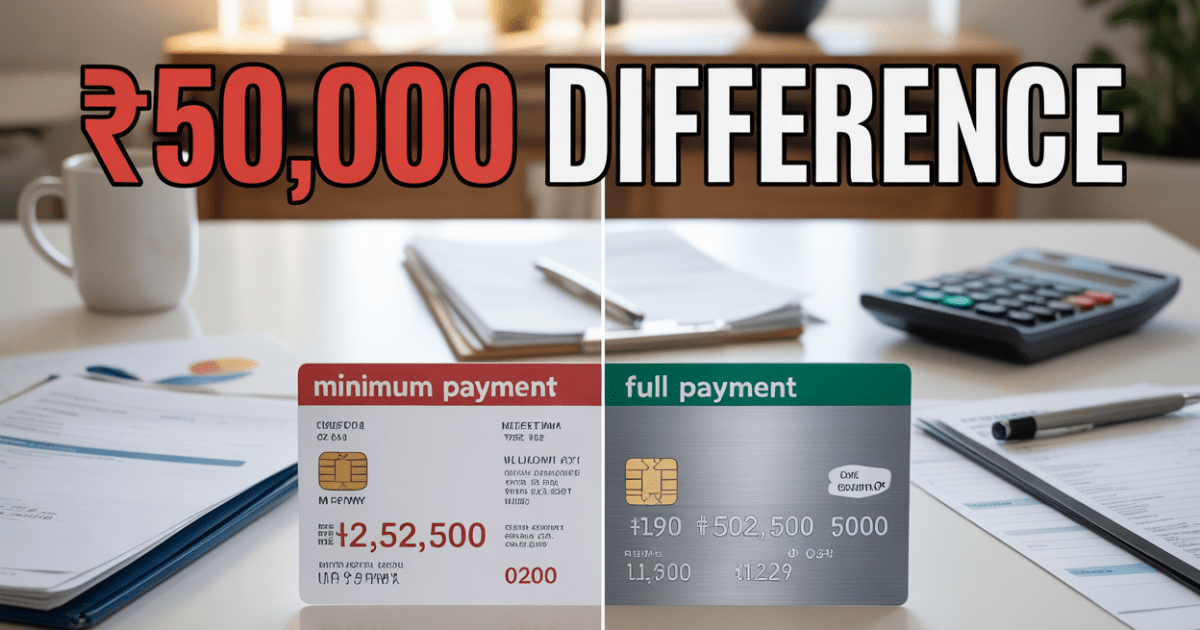
Scenario Comparison: ₹1,00,000 Outstanding Balance
Option 1: Full Payment Strategy
- Amount paid: ₹1,00,000
- Interest charged: ₹0
- Total cost: ₹1,00,000
Option 2: Credit Card Minimum Due Strategy
- Monthly minimum payment: ₹5,000
- Interest rate: 3% monthly (36% annually)
- Time to clear debt: 24+ months
- Total amount paid: ₹1,80,000+
- Extra cost: ₹80,000
This comparison clearly demonstrates why Credit Card Full Payment vs Minimum Due decisions have massive financial implications.
Also read:
👉 SBI Credit Card Minimum Due: Complete Guide to Avoid Financial Traps in 2026
Strategic Benefits of Choosing Full Payment
1. Substantial Interest Savings
Full payment eliminates all finance charges, potentially saving thousands of rupees monthly. These savings can be redirected toward investments, emergency funds, or other financial goals.
2. Credit Score Enhancement
Consistent full payments demonstrate excellent financial management:
- Low credit utilization (ideally below 30%)
- Perfect payment history
- Increased creditworthiness for future loans
3. Maximum Reward Optimization
Credit card rewards and cashback programs become truly beneficial only when interest costs don’t offset these gains.
4. Financial Peace of Mind
Full payment strategies eliminate debt-related stress and provide complete control over your financial future.
When Minimum Due Might Be Temporarily Acceptable
Emergency Situations Only
Credit Card Minimum Due payments should be considered only during genuine financial emergencies:
- Temporary income disruption
- Unexpected medical expenses
- Family emergencies requiring immediate cash
Recovery Strategy Requirements
If minimum due becomes necessary:
- Create immediate repayment plan
- Avoid new credit card purchases
- Consider personal loan conversion (typically lower interest rates)
- Resume full payments within 2-3 months maximum

Advanced Strategies for Smart Credit Card Management
1. Automated Full Payment Setup
Configure automatic debit instructions for the full outstanding amount to ensure you never miss complete payment deadlines.
2. Multiple Payment Strategy
Make partial payments throughout the month rather than waiting for the due date, reducing average daily balance and potential interest calculations.
3. EMI Conversion for Large Purchases
For significant expenses, convert transactions to EMIs with fixed interest rates (typically 12-18% annually) rather than carrying revolving credit card debt.
4. Credit Limit Management
Maintain credit utilization below 30% of available limits across all cards to optimize credit score benefits.
Common Mistakes to Avoid
1. Believing Minimum Due Is Safe
Many cardholders mistakenly believe that paying Credit Card Minimum Due has no negative consequences. This misconception leads to expensive long-term debt accumulation.
2. Ignoring Interest Calculation Methods
Credit card interest is calculated daily on outstanding balances. Even short delays in full payment can result in significant charges.
3. Multiple Card Mismanagement
Using multiple credit cards while maintaining minimum due payments across all cards exponentially increases financial risk.
Impact on Different Financial Goals
1. Home Loan Applications
High credit card balances from minimum due payments can:
- Reduce home loan eligibility
- Increase interest rates offered by lenders
- Delay approval processes
2. Investment Capacity
Money spent on credit card interest (30-45% annually) cannot be invested in potentially profitable opportunities earning 10-15% returns.
3. Emergency Fund Building
Credit Card Minimum Due payments drain resources that should be allocated toward building emergency funds for genuine financial security.
Technology Tools for Better Management
1. Mobile Banking Alerts
Set up immediate notifications for:
- Statement generation
- Due date reminders
- Payment confirmations
2. Expense Tracking Applications
Use financial apps to monitor spending patterns and ensure credit card usage aligns with your ability to make full payments.
3. Auto-Pay Optimization
Configure automatic payments for amounts you can comfortably afford, typically the full statement balance.
Frequently Asked Questions About Credit Card Payments
Does paying minimum due affect my credit score immediately?
Minimum due payments satisfy basic payment obligations but can negatively impact credit scores through increased credit utilization ratios over time.
Can I negotiate credit card interest rates?
Yes, customers with good payment histories can often negotiate lower interest rates, especially if they’re considering balance transfers to competitor cards.
What happens if I can’t afford full payment for several months?
Consider debt consolidation options, personal loans with lower interest rates, or professional financial counseling to avoid long-term debt traps.
How does the choice between full payment and minimum due affect my available credit limit?
Full payments restore your entire credit limit, while minimum due payments leave most of your limit occupied by outstanding balances.
Is it better to pay more than the minimum due but less than the full amount?
Any amount above minimum due reduces interest charges, but only full payment eliminates interest completely and maintains all credit card benefits.
Conclusion: Making the Right Choice for Your Financial Future
The decision between Credit Card Full Payment vs Minimum Due fundamentally shapes your financial trajectory. While Credit Card Minimum Due payments might provide temporary relief during cash flow challenges, they create expensive long-term obligations that can derail your financial goals.
Smart credit card users consistently choose full payment strategies, treating their cards as convenient payment tools rather than lending instruments. This approach maximizes rewards, maintains excellent credit scores, and preserves financial flexibility for genuine investment opportunities.
Remember: Credit cards are powerful financial tools that reward disciplined usage and punish careless management. By prioritizing full payments over minimum due options, you transform your credit cards from potential debt traps into valuable financial assets that support your long-term wealth building objectives.
The choice is clear – full payment strategies provide financial freedom, while minimum due payments often lead to expensive debt cycles that can take years to escape. Choose wisely, and let your credit cards work for you rather than against your financial success.
Always choose wisely when comparing Credit Card Full Payment vs Minimum Due to stay financially secure.
4 thoughts on “Credit Card Full Payment vs Minimum Due: Biggest Money Trap in 2026 (Avoid This Mistake!)”